Wednesday, July 5, 2017

Millionaires, billionaires, who else?


How many millionaires in Australia? You don't know? Okay, I'll make it easier. How many billionaires in Australia?

There are 32, according to the Forbes 2017 list. 32 billionaires in Australia. Do you know what 'billionaire' means? I looked up the online dictionary for a definite definition: a person who has assets of finance at least 1,000 million dollars. That is $1,000,000,000 – one thousand million. Any idea how this sort of assets or finance competes to your own? I can't even work that out.

Gina Rinehart has $15 billion. She's 69th richest person in the globe. The richest person is Bill Gates, from Microsoft, with $86 billion. This year there are 2,043 billionaires around the world – 233 more than last year: the first time more than 2,000.

This year there are 559 billionaires in the USA (Donald Trump is one of them). There are 317 in China; 108 in Germany; 101 in India; 93 in Russia; 66 in Hong Kong; 53 in the UK; 41 in Brazil; 38 in Canada; 36 in France and South Korea; 34 in Italy and Switzerland; 32 in Japan (and Australia); 30 in Sweden and Taiwan; and many other countries which have less than 30 billionaires.

The youngest billionaires this year are from Norway - Alexandra Andresen, age 20, and Katharina Andresen, age 22, both making money from their investments. The oldest this year is David Rockefeller Snr, from USA – he's 102 and makes his money from real estate and investments.

So why do people save a billion dollars, and why do they keep that money instead of helping other people – who, like in Australia, live in poverty?
  • Algeria has one billionaire who made his money from food.... yes, food! Al Jazeera wrote about Algeria in 2014 saying that 23% of that population lives under poverty! 
  • Chile has 12 billionaires who made most of their money from mining, paper and banking, but according to Contact Chile there is 14.4% of poverty in this country.
  • Colombia has a severe poverty of 29%, but it also has 3 billionaires who made their money from banking... and soft drinks. It has been reported by the Borgen Project that Colombia's poverty has cut quite a lot, but there has still been a lot of violence as rural land is stolen from the owners. 
  • Georgia has one billionaire but Georgia has 17.1% population in poverty. 
  • Guernsey has one billionaire but Guernsey had 22.3% population in poverty (2014 reported in their 2017 pdf).
  • Iceland has one billionaire but Iceland had 9% in poverty. 
  • Romania had one billionaire and yet it had the “highest relative poverty rate in the EU”, according to Romania Inside. 25.1% of the population.
  • Slovakia has one billionaire who got his money from real estate, but Slovakia has a poverty of 13%.
Nigeria has 3 billionaires with their funds made from cement, sugar, flour, telecom and oil, and yet it is the only country I found which has increased its poverty between 1990 and 2013. Why on earth would billionaires live there if they would never give to their countrymen?? 

The Philippines is one of the worst – 14 billionaires live there, while around 26% live below poverty. That would be around 26 million people with their population at 103 million. The Philippines is rated as 13th populated on the globe – yet it is far behind many western countries for poverty. 

So how does Australia fare? ACOSS (Australian Council of Security Services) wrote a report in 2016 titled Poverty in Australia 2016. Australia is considered against OECD countries, and ACOSS found that 13.3% of the Australia population is “living below the internationally accepted poverty line”. There are, on the DSS spreadsheet workpage titled 'Payment by Rate', 2,497,468 beneficiaries not counting aged pensioners. Forbes said there are 32 Australian billionaires. There are, undoubtedly, many, many millionaires, but Forbes didn't count them in the report I looked at. There are, this year, somewhere around $89.7 billion dollars in Australia belonging to just the billionaires. I used to think I'd be angry when I found out this sort of stuff. Now, I'm just sad.

The DSS spreadsheet is very interesting – I can use that in the future. But for now I am looking at the Australian billionaires, thinking of the Australian millionaires (I even know some of them) and thinking of where I am living now. I'm pretty sure no rich people live here.

The quote I've printed here says what I feel – not just for children, but for anyone who does need it. I hope a millionaire – or a billionaire - will listen to me.


Saturday, July 1, 2017

What is "religion"?

I know that Wikipaedia information is not believed by everyone, but bear with me and read on. According to Wikipaedia “Religion is any cultural system of designated behaviors and practices, world views, texts, sanctified places, ethics, or organizations, that relate humanity to the supernatural or transcendental. Religions relate humanity to what anthropologist Clifford Geertz has referred to as a cosmic 'order of existence'.”

The trouble is that there are rarely, throughout the world, countries which agree! Word Atlas said that Christianity is an Abrahamic religion, the same as Judaism, Islam, Ba'hai and others. Hinduism, Sikhism, Buddhism and others are Indian religions. Taoism (or Daoism), Cao Dai, Shingyo, Shintoism and others are Asian. Wikipaedia has a breakdown of the denominations.

In Wikipaedia, Christianity was shown as at 2010 as the predominant religion, followed by Muslims. The third is atheism – no religion. What surprised me the most was that New Zealand, where I was born, had a 42% of atheism within their country! That % includes agnostics. I had a look through the 2013 census which was quoted on Wikipaedia as a reference, which noted 41.9%. That has increased a lot between 2006 (34.6%) and 2013 (41.9%). As mentioned earlier, 52.1% for the 2016 census were Christians – a large drop. The next census will be 2018 – I will be watching.

Gabe Bullard wrote an article for National Geographic in April last year, talking about how non-religion is growing - and quickly. Bullard said that the lack of religious affiliations has changed how people bring up their kids, how they react to death and how they are now living. And he said that “France will have a majority secular population soon. So will the Netherlands and New Zealand. The United Kingdom and Australia will soon lose Christian majorities. Religion is rapidly becoming less important than it’s ever been...” Maybe that's where it should end up.

In Australia the predominant religion is Christianity, including all the sub-dominant affiliations, but it's now losing out. The ABS stats report of the 2016 census said that 52.1% of the people in Australia were Christians, but a further 30.1% said they had no religion, which includes atheism, agnosticism and 'Secular Beliefs and Other Spiritual Beliefs and No Religious Affiliation'. What surprised me in this country is how many people truly believe that Islam is “taking over”, when, on the census, only 2.6% people claim Islam as their religion.

News Limited wrote in an article titled ‘No religion’ tops religion question in Census on 28 June that Australia is growing into a non-believer country. It mentioned 1966 as 88% Christian and has now dropped. Maybe that is why people like me moved here – a decent life, good jobs, good money... until you end up homeless, unemployed and in poverty. That's another story... but non-religion is the present. It should be.

ABC's religion and ethics writer, Barney Zwartz, a senior fellow of the Centre for Public Christianity, media adviser to the Anglican Primate of Australia and a freelance writer (he said), wrote in August about the demise of religion. Zwartz converted from agnosticism many years ago when he was 24 and considered himself up to date with his religion, yet “the fact is the world of religion, for most newsdesks, is an alien world, and as budgets and space have shrunk they have focused ever more on politics and sport, court or crime stories - which are cheap and easy - lifestyle stories, and eventually clickbait.” He thinks that “anti-Catholicism” is a new “anti-Semitism”. Could he be right? I dislike the fact that he thinks he is.

At the end of his article Zwartz quoted. The first was from Sir Noel Coward - “It is discouraging how many people are shocked by honesty and how few by deceit.” Coward was agnostic. He wrote “Do I believe in God? I can't say No and I can't say Yes, To me it's anybody's guess.”.

The second was from Joseph Heller's novel Something Happened - “Every change is for the worse.”. In an interview in Australia in 1998 Heller had said that “The only wisdom I think I've attained is the wisdom to be skeptical of other people's ideology and other people's arguments. I tend to be a skeptic, I don't like dogmatic approaches by anybody. I don't like intolerance and a dogmatic person is intolerant of other people. It's one of the reasons I keep a distance from all religious beliefs. I think in this country and in Australia too there's a late intolerance in most religions, an intolerance, a part that could easily become persecutions.” Non-religious?

The third was from a previous USA Vice President Dan Quayle: “The future will be better tomorrow.” I haven't read anywhere in his biographies that Quayle was religious, but that wouldn't worry me. What worries me was reading his quote in a religious article. Zwartz finished his article with another comment after Quayle's quote: “Isn't that comforting? But Christians know it is true.” Zwartz gave me a shiver up my spine. I'm atheist. If the future is better tomorrow, then seriously, we need a NEW government, NEW beliefs and NEW trust of people in this country who say they are “religious”. Unfortunately, religion drags money far too far away from Australia – and everywhere else around the globe. Poverty? In a country like Australia?

Atheists know it's true.


Thursday, June 29, 2017

Australia's Health

On Monday this week I'd been into the local library to do some photocopying. Normally, after that, I'd leave, but this time I had a strong feeling about looking around. My preference was non-fiction, so I looked at the signs on the shelves and found the social and law areas. I don't know just what I was looking for, but that sounded like me. 360-363.9 was Sociology to Social welfare, problems & services – yes, that would be me. I took a couple of books out of the shelf and had a look through them, and the third one really got my eye – it was titled “Australia's Health 2016”, provided by the Australian Institute of Health and Welfare (AIHW). Maybe I would have been counted into whatever they reported.

I checked the book out and took it home to read.

This is the “15th biennial health report of the Australian Institute of Health and Welfare”, presented in 2016 to (ex) Minister Sussan Ley. All material in this book is covered by the AIHW copyright under Creative Commons - Copyright © Australian Institute of Health and Welfare. Please note that if you will use any of the writing from this book which I have quoted in my blog.

There are seven main chapters:
  • An overview of Australia's health
  • Australia's health system
  • Leading causes of ill health
  • Determinants of health
  • Health of population groups
  • Preventing and treating ill health, and
  • Indicators of Australia's health

I moved to Eagleby in November last year. I didn't choose it, but I was mistreated by the retirement village where I'd been for a short time (5 months). For it's population (around 11,900) Eagleby has a lot of retirement villages, including Oxford Crest, Ruby Living Gems, Palm Lake Resort and Sapphire Living Gems and a lot of unemployed people. The unemployment stats were a lot higher than the rest of the country – 12.6% as against 4.9% federally in 2011 - and 47.1% renting against 31.4% federally in 2015. ABC reported in February this year the sort of problems renters have federally with unhealthy rentals, starting with the introduction which said “Let's just say the latest national snapshot of the state of renting a home in Australia does not paint a pretty picture”.

Eagleby is 35.8km away from Brisbane CBD (and only 45.2km from Gold Coast CBD), and it's included in Brisbane's low socioeconomic groups. I'm a DSP recipient due to my stroke with aphasia. Before that I had a job, I had a very good education, but now I can't work so I am included in the low socioeconomic group. This book explains it on page 183 (Chapter 5.1), saying that there is a “composite measure such as the Index of Relative Socio-Economic Disadvantage (IRSD)” based on “low income, low educational attainment, high unemployment and jobs in relatively unskilled occupations”. Chapter 4 looked at 10 facts about social determinants to low socioeconomic people (Box4.1.1, page 130) – bullet point 6 says “A higher proportion of people with an employment restriction due to a disability lived in the lowest socioeconomic areas (26%) than in the highest socioeconomic areas (12%) in 2012 (AIHW analysis of ABS 2012 Survey of Disability, Ageing and Carers)”. Very unfair for people with disability.

Chapter 3 provided a diagram titled “Top five leading causes of premature death, by age, 2011-2013”. 'Premature age' is earlier than your age group might be expected to die. In Australia, it seems, the median age of dying was 82 years old in 2013. Perhaps that's more nowadays. Whatever you belong to (by your age), see if you can identify with deaths within your age group. For me, the 'cerebrovascular disease' includes stroke but doesn't include my age (45-64) – and yet that age includes suicide. Maybe they did know me!

The book looks at stroke in Chapter 3.6 (page 90). My heart had stopped during my brain aneurysm surgery, was re-started, and the stroke happened then. According to the book, 377,000 people throughout Australia had a stroke within their lives (171,000 of those were female), and 71% of those were over 75. The people who had a disability from that fell from 45% in 1998 to 39% in 2012. I have no idea how that would work out for me, but my maths are simple: 29% of 171,000 = 45,590. 39% of that = 17,780. That, to me, is 17,780 females who had a stroke throughout their lives who are now disabled. That, it seems, includes me. It also said that “[d]edicated stroke units in hospitals significantly improve the health outcomes of patients.” Many of those under the age of 75 with aphasia don't seem to improve 'significantly' enough to get back to work.

This chapter also said that “[p]eople living in the lowest socioeconomic areas also had higher rates of stroke”, but it doesn't mention that people who had a stroke have been down-graded and moved to a low socioeconomic area from a medium socioeconomic group.

Chapter 5.9 (a very short 2-page sub-chapter) looks at Health of Australians with disability, but it looks at obesity (70% disabled against 60% non-disabled), lack of exercise (46% against 31%), smoking (31% against 15%) and psychological distress (22% against only 1.2%). This part of the chapter only looks at people aged 15-64 and not older people because, they say, “NHS excludes institutional care settings and therefore underestimates disability prevalence among older people”. The 'excellent/very good' stats have gotten worse since 2007-08, even for “no disability or restrictive long-term health condition”, by 2011-12, but the 'fair/poor' have grown.

Obesity is not precluded by people with disability, but it occurs to people like us because many of us can't meet an exercise limit, we feel psychological distress as we are teased or abused by people in 'normal' positions, and we simply feel that smoking is something we can have control of. What else could we control?

NDIS is not mentioned at all throughout this book, but they have looked, so far, at the National Disability Strategy 2010-2020, and quotes one of the main outcomes as “[p]eople with disability attain the highest possible health and wellbeing outcomes throughout their lives (DSS 2012)”. Previous meetings to 'learn' about NDIS have been written about in my blog before (What will NDIS do for us?, Tuesday 27 October 2015 and NDIS still??, Saturday 15 April 2017). I've seen NDIS too much to even understand it! NDS's 'outcome' quote, above, still doesn't reflect the 'highest possible' recovery for us.

This book is very interesting and very close to 'now'. I've never seen anything like this before (even though it's supposed to have been done every two years), but I think it's confirmed a lot that I now feel about health in Australia, especially to people from low socioeconomic areas. As a person with a disability, I would never have expected to end up here, but I have lived with a disability for the last 3 years. I feel so... frustrated, sad... for the people who have lived in these sorts of areas for most of their lives, either with a disability or a low education. This government – ANY government – owes a decent life to anybody who lives here, regardless whether they are citizens, whether or not they are able to or can work.

I wonder if that will ever happen.


Tuesday, June 27, 2017

“Retirement” villages

Last night I watched an ABC 4Corners program, reported on ABC News, about Aveo, a retirement village company. Aveo is owned by a Malaysian man, Seng Huang Lee. His father had been jailed in Hong Kong for corporate deceit, yet Seng is very, very rich. He, it seemed, has Aveo as a “get rich quick scheme”, according to Lander, a retired diplomat who wears a bow tie. It had taken Lander many, many months to understand the extortive contract he had signed. This “company puts profit before people”, he said.

The program was about retired people who have been ground down inside their own property, which they had bought. Now, if they want to sell it and move out – or were kicked out – they were charged an “exit” fee, along with anything else that Aveo would take from them. 4 Corners interviewed a number of retired people who were being mistreated by Aveo. One man who's partner had died wanted to stay. He had been together with his partner for many years, he and his partner had bought the unit, but only his partner's name was on the contract. Aveo didn't care how he felt, they just kicked him out – and charged him an exit fee. Others were mistreated:
  • One bought for $135,000 but 4.5 years later as it was sold to Aveo; they ended up with only $48k.
  • Another couple sold for $159,000 but would only end up with $58k from Aveo.
  • One woman, diagnosed – by Aveo – as having dementia was moved in to a hospital but charged a maintenance charge every month while she wasn't in her own unit. She is now fighting Aveo.
“Exortive” is defined by the dictionary online as “To obtain by coercion, intimidation, or psychological pressure”. Aveo is not the only retirement village which does this. The Park View Retirement Village in Bethania, where I stayed for 5 months, was just as bad. That property owner had acted similarly:
  • Aveo charges $6,000 per year for “corporate fees”. I paid $100 each week ($5,200 per year) for “management fees”, which I had found out about when I got my Tenant Ledger. I had thought it was supposed to have been for the food I ate, yet even when I stopped paying for their food the “management fee” still appeared on my Tenant Ledger: they were then taking it out of the full rent I paid!
  • Aveo changed some of its villages from “Retirement” to “Aged Care”, without telling anyone who already lived in them. Park View Retirement Village didn't changed their sign – it still says Park View Retirement Village – but I was told it was not a “retirement” village but a “senior” village.
In my blog on 1 January this year I wrote of the past year. For November 2016: “Wrote a blog about site manager calling me names - “Nutcase” 1 November. Dom (friend) committed suicide – self-invoked hunger while he waited to die from asbestosis. Blogged about him in “Asbestosis” on 7 November.... Attempted suicide later this month; taken to hospital and kept overnight. Locked out of my unit by the site manager when I got back, illegal. Ongoing communication with police, Tenants Qld, Q-Star, YFS and others for help.” Later, 9 April, I wrote about how I had felt from the illegal mistreatment I'd been under at Park View Retirement Village. The blog was titled Anxiety, Stress, Depression, PTSD, Stroke, Suicide – what's the difference? That was exactly how I'd felt. Like many, many other retirement village residents, I hadn't realised that too many retirement villages are extremely bad with their behaviour and their treatment of residents. Before 4 Corners and now, I have felt very sad for other retired people who are treated like me.

I am just starting to realise (too late) that the behaviour of people in this country has downgraded in the last 5 years. Anyone without decent (any) money is pushed to the background. Many end up homeless. Older people with money are rorted by dishonest schemes.

This program will be repeated today (Tuesday) at 10am, Wednesday at 11pm on ABC and on Saturdays at 8.00pm on ABC News 24. Please watch it if you didn't yesterday.

I will just say that I am now feeling much, much better in my unit which is not part of a retirement village like I had been at the end of last year with mistreatment by two non-Australian managers of the retirement village. They weren't Seng, but they were close. That sort of bad behaviour doesn't fit in here.

We must rid ourselves of it.


Saturday, June 24, 2017

School of Hard Knocks

What is School of Hard Knocks? Have you ever heard of them? Well, it seems, a lot of people had. On October 7 2016, the School of Hard Knocks was advertised as participating in a “Hope and Inspiration Tour” at QPAC. I missed it - I'd read about it about two days too late. It had been the 10th anniversary celebration for SOHK from Melbourne, but I found out that the Brisbane SOHK choir existed – and had been around for 3 years. This choir grabbed my interest, and I contacted them through email – and was asked to join... so I did!

From October last year I've been as busy as anyone else in the choir, and I love it! We meet at Common Ground on Hope St in South Bank for practice every Friday during normal school terms. We had a lot of practice for external trips where we would perform.

My first trip with the choir was to the State Library for a performance with the SLQ “10 years - Library of the future”, which celebrated on 12 November 2016. Our next performance was on 14 November at Moreton Bay College, which was all-girl. We had two shows: first up, Absolutely Everybody choir followed by the Rhythm of Life, which was a “Music Theatre [which] include movement, acting and singing” - also from SOHK. On 9 December we performed for the Qld Mental Health Commission, and our final 2016 performance was on 16 December at the SLQ theatre The Edge for our christmas concert.

That was when I found out about Streetbeat, a percussion group which uses “buckets, bowls, cups and anything else we can find, we’ll have plenty of instruments for all attending”. I was drawn in by the cup song “When I'm Gone” from the movie Pitch Perfect. I joined that too – practice at South Bank every Wednesday morning. This year we started with a Streetbeat performance in Redcliffe on 17 March at the Encircle community place in Lamington Drive. Our team played for supporters, and we even gave them some lessons. Very recently we played a percussion drum beat on our buckets for one of my favourites, the Queen song “We Will Rock You”!

The SOHK choir's first performance this year was one I missed because the floods hit Beenleigh and took out the Beenleigh train station! That was a private concert for families and supporters at Common Ground at the end of term 1. Our next was at Stamford Plaza Hotel in CBD, a riverside stage from where we performed for the Baptist evening.
On the recent Thursday evening we went down to the Gold Coast to the  CEO night-over at the Cbus Super Stadium at Robina. We had a rugby player's room to wait in... it was damned cold outside of there! We went into the open hall area and had some sound streaming before we could go and get some soup and bread for dinner and wait in our area. We did three numbers that evening, including audience involvement with the John Farnham song “You're the voice”. 

Yesterday we had an end-of-term get together. It was a special event for all choir people and some from the Rhythm of Life and we ended up doing a flashmob at the SLQ for a lot of their clients! We were told that the words were written by Melissa Gill, our director – I've printed them here (and my apologies if I got that wrong... but I don't think I did)! There's a post from the State Library on their Facebook page along with a video of the mob – they loved it! We finished there with “You're the Voice” - yes, John Farnham's wonderful song.

This year we're practicing for the “You’re The Voice” choral event which will be held at Piazza in South Bank on 29 July 2017, with 2,500 other choir people also joining in. Have a look at the Queensland Music Festival page, read about why it's being done, and come along and watch us all on 29 July! I've also included links to our own QMF advertisement - where I speak in it! - and the QMF pdf page which was a media publication telling about the whole events between 7-30 July. Printed it out and pass it on to your family, friends, business, community!

This choir is a busy, lovely, great group to belong to, and I feel so much at home. If we advertise anything we are publicly performing, I invite you all – and your family and friends – to come and see us. If you have just a little bit of money available, visit the SOHK website and donate.

Support us – and we'll love you!!

Sunday, June 18, 2017

Success or failure #2

Yesterday I wrote about some information I had researched, regarding to the failure of people – women - over the age of 50. This morning I continued with that, and found many other websites which provided me with more information which I found relevant.

Clarissa Bye wrote for The Advertiser (Daily Telegraph) on 29 April about Ageing women in financial strife the new face of Australian homelessness. She wrote about lack of super, casual jobs and high-priced housing, and spoke about Dr Ruth Skilbeck, a “published author with a PhD in literature [who] went from a Mosman residence to being penniless and unable to find work.” She said that “government stats are showing half a million women will fall into housing stress over the next two decades”. I know about this because that happened for me – and I'm 60. She also said that “26 per cent of people living alone report feeling lonely often, compared with 16 per cent of people living with others”.

There were some stats added to this article which made me feel very vulnerable:
  • women over 55 are the fastest growing group of people experiencing homelessness
  • 59 per cent of Australians seeking help from homelessness services are women
  • women over 50, after many years of loyal service, are made redundant and can no longer afford to pay high private rentals
  • 700,000 Australian women over 45 are single, earn less than the median income and don’t own their own home, and
  • 500,000 women are likely to fall into housing stress over the next two decades
These were her own stats. I didn't make them up, but they relate to so many people like me.

Nick Evershed wrote for The Guardian about Australia's divorce rates: the real statistics (28 May 2013). I already knew about these. My ex left me in January 2013 – no real reason. Evershed said “New figures from the Australian Institute of Family Studies have shown a big increase in people divorcing after 20 years or more of marriage”; for me, it was under 10 years.

Evershed's points included:
  • the age that people get divorced has increased dramatically
  • the median age of divorce for men is at 44.5 in 2011, and women are similarly high at 41.7 - the highest since 1970
  • 12% of children were with only one parent by 2010 , and
  • unmarried couples cohabiting is 27% - more than twice as likely to break up
Professor Edwards for ANZSOG Institute for Governance, 26 July 2013, wrote Not Yet 50/50: Barriers to the Progress of Senior Women in the Australian Public Service Report. Her report seemed very much similar to others which spoke of barriers to women. She spoke well, but what she said could be filed away by men who didn't really care about the women in their industry.

Her points included that:
  • men were unlikely to look beyond women’s duties as mothers
  • women pointed to exclusion from networks, personal style differences and male stereotyping as well as family-related barriers and a lack of confidence, and
  • different leadership styles can impact on a woman's career progression
Professor Edwards' report is available as a pdf if you would like to download it.

In 2011 – before Professor Edwards' report - Mark Evans wrote that “[m]embers of the Institute were concerned that data on the representation of women in the ‘most’ senior echelons of the public service in Australia showed a decline despite the election of Australia’s first woman prime minister and governor-general.” 

He wrote this year When Meritocracy fails females: a culture shift to 50/50 (8 March 2017) for Broad Agenda. The following points were his own comments from his article from this year about how women fit in:
  • Competing priorities/family responsibilities hinder women from taking up demanding leadership roles.
  • Negative male perceptions of a woman’s ability to lead impede women’s progression into leadership roles
  • Workplace structures and cultures hamper women’s progress by distilling processes of unconscious bias that afford comparative advantage to men with the requisite attributes.
  • Workplace cultures and practices undermine the self-confidence and self-belief of women in seeking career advancement.
Extremely sad... or frustrating. Women have the right to believe they can move up in the “male management” as they fit, but too often women don't for... what reason? Meritocracy? Motherhood? Or men rule?

Has it changed now? Will it change?

Accumulating poverty? Women’s experiences of inequality over the lifecycle was a report written by principal author Somali Cerise and her group for the Australian Human Rights Commission in September 2009. This report looked primarily at superannuation, and how women get so much less than men – and why. The report said that “[i]nstead of accumulating wealth through the retirement income system as intended, due to experiences of inequality over the lifecycle, women are more likely to be accumulating poverty”, which, on reading, would make women feel pretty frustrated, yet most men feel good for how well they did. So why are men, at retirement (65+), sitting on more money than women? Is this still going on? It's now 8 years since this report!

Max Opray, in his article Govt plan for older workers falls short (29 October 2015) said “The employment situation only got worse for mature-age workers after the launch of the program – in the year to January 2015, there were 80,000 unemployed Australians aged 55 and over, an increase of 12 per cent over the year before.”

In 2013 I received my Grad Dip OHS which I had spent two and a half years studying for. I was 56 then; now I'm 60. Sometimes I feel grateful that I am on DSP because of my stroke – and I have no other income because I can't work now. Yet other times I think I am no different than many other women who are old and unable to get a job. Part of the 12% increase, maybe.

Women over 50 can work if they find decent work. 

Maybe you can help us.


Saturday, June 17, 2017

Success or failure

When I started looking up on Google for info about comparison of success and failure, many of the articles I found were USA-written and about school. I read on: that didn't have to convince me that USA is overcome with differences between failure and success, but I had a look through. I started as a skeptic, but the more I read the more I was intrigued.

NY Times said the “secret to success is failure”. Is it? Early in this article it said “Riverdale is one of New York City’s most prestigious private schools, with a 104-year-old campus that looks down grandly on Van Cortlandt Park from the top of a steep hill in the richest part of the Bronx.” Private school? Was that necessary? The headmaster, Dominic Randolph, seemed to have changed some of the education facilities for this school – an expensive school. Was that necessary?

For the headmaster of an intensely competitive school, Randolph, who is 49, is surprisingly skeptical about many of the basic elements of a contemporary high-stakes American education. He did away with Advanced Placement classes in the high school soon after he arrived at Riverdale; he encourages his teachers to limit the homework they assign; and he says that the standardized tests that Riverdale and other private schools require for admission to kindergarten and to middle school are 'a patently unfair system' because they evaluate students almost entirely by I.Q. 'This push on tests,' he told me, 'is missing out on some serious parts of what it means to be a successful human.'

The writer then spoke about a different school, the KIPP Infinity middle school in Manhattan which supplied education to students who were black or Latino and from low-income families. Randolph from Riverdale and Levin from KIPP were both, it seems, intrigued with Seligman and his co-writer, Peterson, who had had just finished an 800-page book titled Character Strengths and Virtues: A Handbook and Classification which was, apparently, a “manual of the sanities” and a “science of good character”.

That sounded pretty good, but how would it affect those who finished (or not) Year 7 at school, had attended (or not) a university, and had a job and grew older? Or did they not? Perhaps that one was just supposed to be read by parents whose kids go to any school, even if it wasn't “intensely competitive”.

Next, I found 99U which wrote about Tim Harford's new book, Adapt: Why Success Always Starts With Failure. Harford identified some of the wrong ways to react to failure, including denial, chasing your losses and hedonic editing. The writer said: “We’re so anxious not to 'draw a line under a decision we regret' that we end up causing still more damage while trying to erase it.”

That might have sounded true, but the “recipe for Successful Adaptation” seemed to have too many points:
  • try new things
  • experiment where failure is survivable
  • recognise when you haven’t succeeded
  • gather feedback
  • remove emotions from the equation
  • don’t get too attached to your plan
  • practice disciplined pluralism
  • finding “a safe space to fail is a state of mind”, and
  • imitate the college experience
The “college experience” was the point that frustrated me (funny how it was at the end). I couldn't imagine all of these points worked, at least in Australia, for many or most people. How many people went to “college”? How many would even go to university? How many people do this for their success? Have you ever heard of any of this before?

The next article was from Amy Edmondson from Harvard Business Review – yes, still USA. (Give me a little bit of time, I am attempting to compare USA to Australia!) So this writer had been looking at enterprises for 20 years. She'd already looked at “pharmaceutical, financial services, product design, telecommunications, and construction companies; hospitals; and NASA’s space shuttle program, among others”. Did it even included retail or tourism, which – at least in Australia – are huge enterprises?

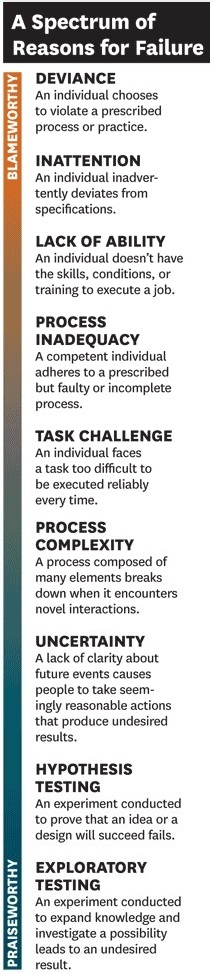
Edmondson wrote that a

“sophisticated understanding of failure’s causes and contexts will help to avoid the blame game and institute an effective strategy for learning from failure. Although an infinite number of things can go wrong in organizations, mistakes fall into three broad categories: preventable, complexity-related, and intelligent.”

She understood this, but would everyone? She provided a “Spectrum of Reasons for Failure”, from blameworthy to praiseworthy. Looks pretty good, but would everyone understand it?

Onwards to Australia articles. Monthly produced “A rich history of failure: Australian history according to undergraduates”, written by Professor Neve R Stenning-Stihl (really??) in 2014. Methinks this is satire, but have a read and think about it - perhaps that is definitely a printed 'failure' here!

“Many Australians viewed their history sheepishly. In 1841 the average number of sheep per shepherd was 450. In comparison, in 1851 each shepherd was in the care of over 1000 sheep. In the 1840s depression the sheep were burned down for tallow and candlemaking. But the introduction of Alien species to the environment compounded the effects of soil erosion with hooves and the tendencies of European animals to up-route fauna.”

or

“In the 19th-century city, prostitutes occupied a variety of positions. The historical impression of prostitution notoriously has a shady storyline suspect to more probing. Prostitutes are commonly depicted as being very sexually promiscuous. Some historians suggest that the history of prostitution is largely oral.”

Okay okay, I've stopped laughing now....

John McDuling, writing for AFR, looked at the subject with comments which pulled me back onto the straight and narrow road - new start-ups. So what is a “start-up”?

Wikipaedia says that “A startup company... is an entrepreneurial venture which is typically a newly emerged, fast-growing business that aims to meet a marketplace need by developing or offering an innovative product, process or service.”

Investopaedia said “A startup is a young company that is just beginning to develop. Startups are usually small and initially financed and operated by a handful of founders or one individual. ... In the early stages, startup companies' expenses tend to exceed their revenues as they work on developing, testing and marketing their idea.”

The Investopaedia explanation is probably much more relevant for start-ups in Australia. McDuling said that 90% of start-ups will fail - “they don't make it to a trade sale or IPO, and are wound up.” He claims that “success is the exception, not the rule.” He says that start-ups are most good, even if they fail - “there are also honest failures, where for whatever reason, it just doesn't work out. And the best venture capitalists expect to back lots of them.” Does the entrepreneur learn from its failure?

Adam Courtenay, writing for SMH last year, titled his article Small business and start-up failure rate: is it a cause for concern? He told us that D&B's economic adviser, Stephen Koukoulas, said that “[t]he high proportion of business start-ups and failures was largely due to a weakness in overall retail spending, he said, but could also be attributed to aggressive competition from large retailers...” Weakness in retail spending? Aggressive competition from large retailers? Oh dear...

Yet those stats aren't just for Australia, they are global, according to Karen Lawson, CEO of corporate start-up accelerator Slingshot. So how is that for Australia, compared to, say, Zimbabwe? Lawson says we need customers and finance and resources, so why don't we have them? Why do we fail?

Is failure a secret to success? Do all the start-ups which fold over actually success, or are they actually failure? Do our school kids need private schools to become success? Do we need a lot more than 10% of start-ups to succeed?

I read too much tonight... maybe I should feel I failed. Or succeeded.

I think I need another red wine.